
 Buy Tickets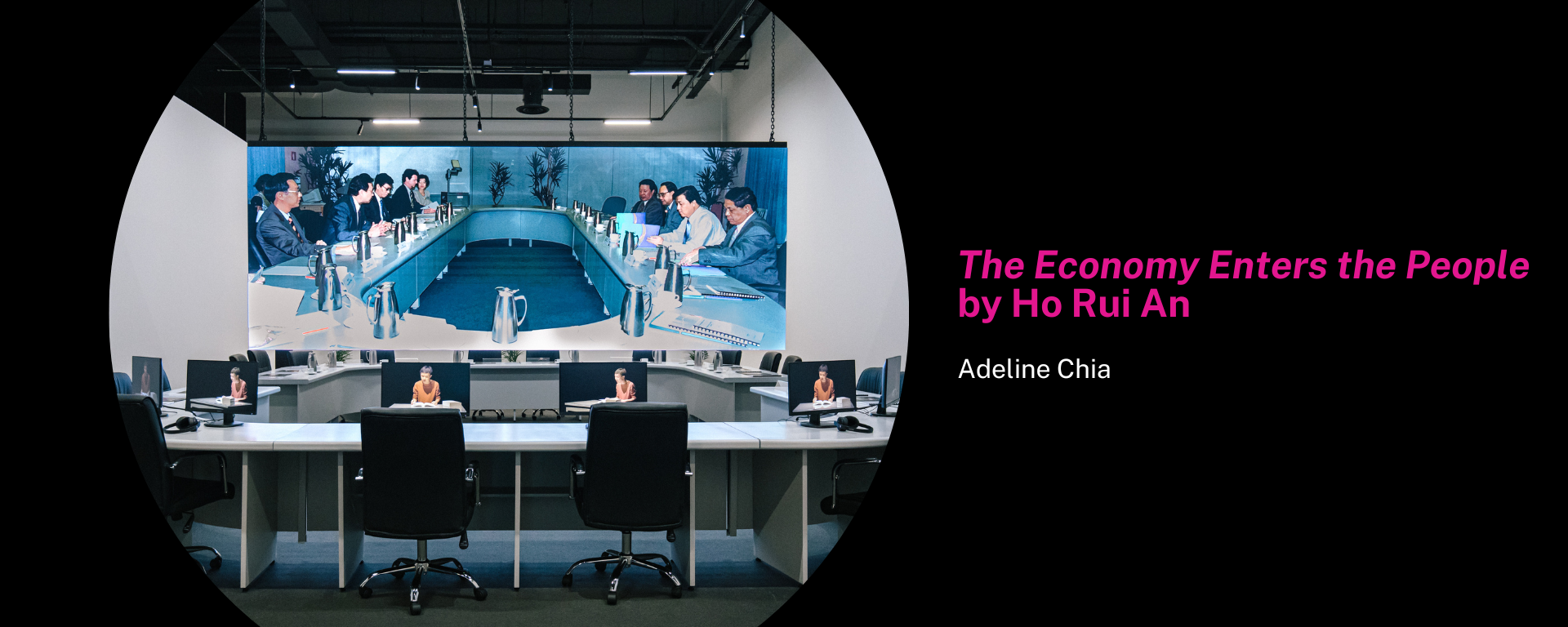
The Economy Enters the People
by Ho Rui An
15 Jun 2026
Images are unpredictable. Whether by accident or design, they can collude with power or undermine it, and obscure or reveal material realities. The slipperiness of images is instrumental in the work of Singaporean artist Ho Rui An, whose wide-ranging investigations focus on the relations between labour, capital and ideology and their representations. Over the past decade, Ho has built up a diverse body of work that includes installations, video works, photography and lecture-performances, for which he is best known. Intellectually eclectic and politically critical, his lectures weave together history, economics, theory, film, propaganda and art. With the accelerating circulation of images around the world, the deconstruction of visual culture has become a lynchpin of Ho’s work. Supported by found video clips and photographs, his lecture-performances examine the ways media have been instrumentalised, commodified and monetised, and, on the other hand, how images take on new meanings over time.
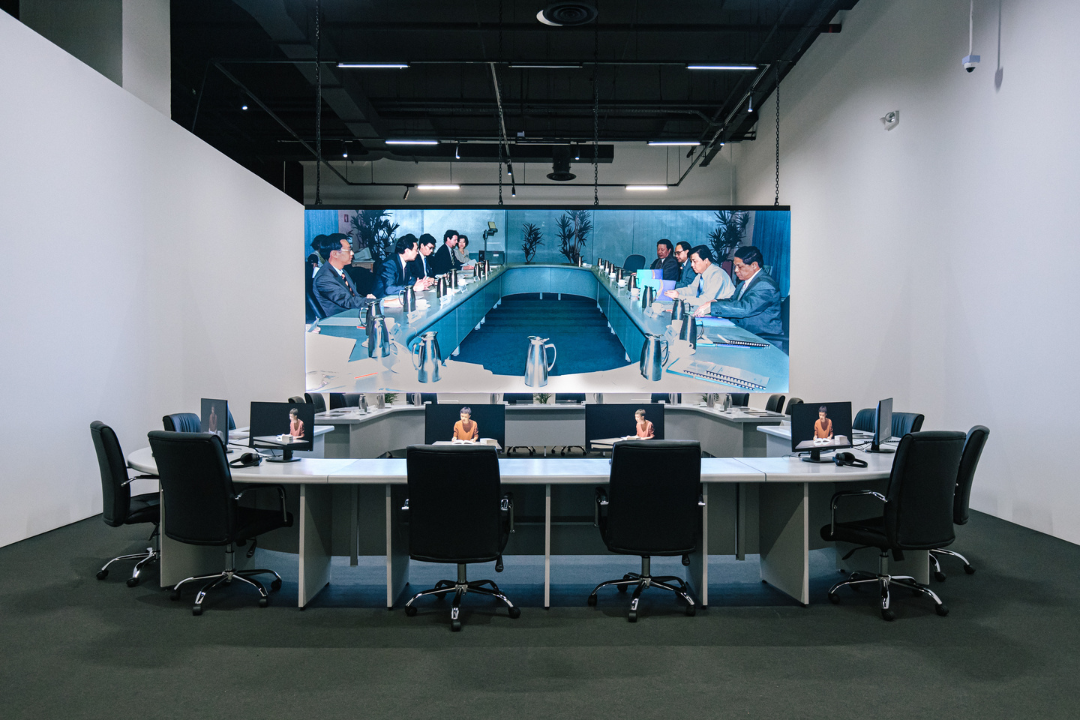
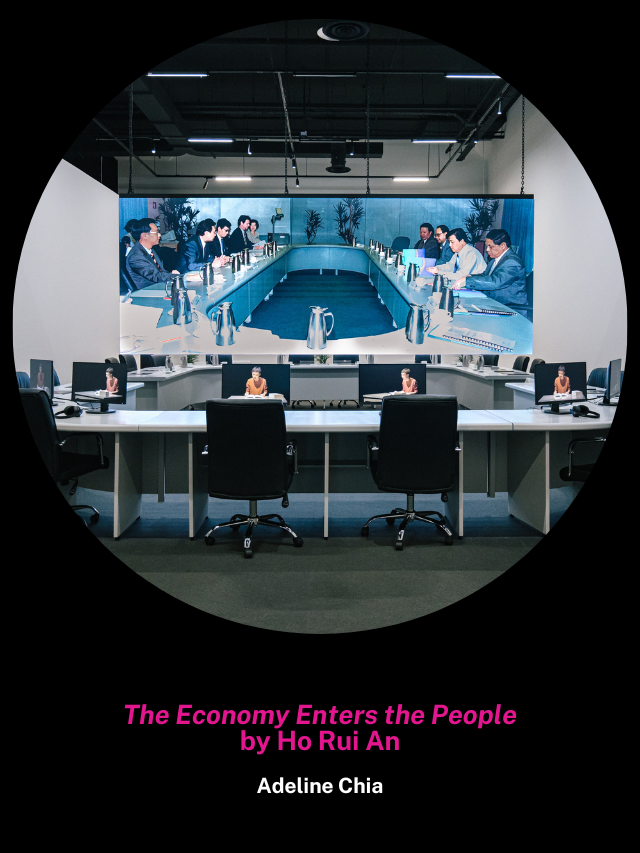
2021–22. Lecture and video installation with digital prints on paper, conference table, office chairs, desk, stool, book trolley, books, thermos flasks, cups, saucers and acrylic name plate holders. Installation view, 'Lonely Vectors', Singapore Art Museum, 2022 Courtesy of Singapore Art Museum
“Images almost never do what they are told,” Ho says in the performance-lecture and video installation The Economy Enters the People (2021). The 84-minute video component of the work is a deep dive into China-Singapore relations during the 1990s and the way both sides mirrored each other’s methods of circulating images, when the Chinese Communist Party sent cadres to Singapore to learn methods of regulating the internet, planning cities and controlling corruption. Ho highlights the way both states worked to give the impression that a factory was opening every day, to promote their business-friendly environments to investors. In a section compiling footage of officials being photographed at opening ceremonies, the Chinese side infamously reused the same plastic table cover with a lurid floral print at four ceremonies within one day. “Like the flowery patterns on the tablecloth,” Ho narrates, “the images from each ceremony were imagined as part of an infinitely expanding series”—an endlessly proliferating chain of factories, and endless economic growth.
For context, Singapore is allegedly the only country that China’s top leaders have publicly claimed as a learning model. The lessons China gleaned and implemented from Singapore statecraft, comprising soft authoritarianism and high economic growth, have been well documented by political commentators, with the friendship between the Chinese strongman Deng Xiaoping and Singapore’s first prime minister Lee Kuan Yew being especially celebrated and fetishised in the Sinophone world. The story goes that Deng, who was seeking to modernise his country’s economy, which had been crippled by decades of Maoist-era policies, was so impressed by a trip to Singapore in 1978 that he started sending his civil servants to take pointers from the political and economic playbook of Singapore. The lessons that the “Singapore model” provided rested on the idea that the city-state achieved advanced industrialisation without substantial political liberalisation and combined soft authoritarianism and good governance. 1
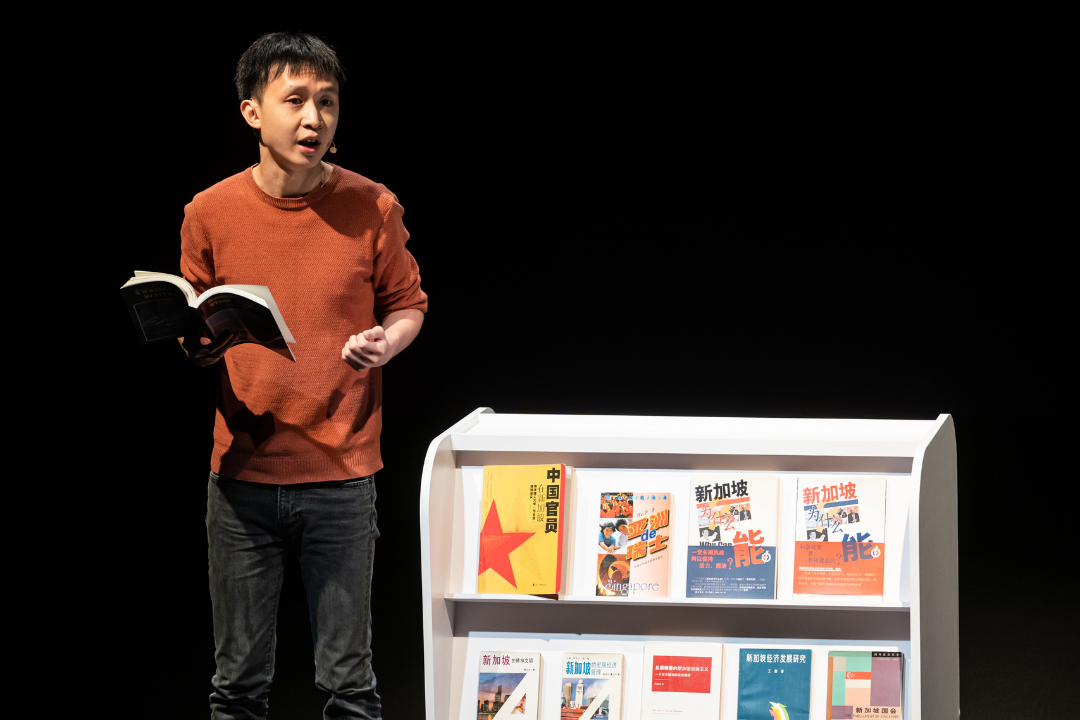
'The Economy Enters the People'. 2021–22. Documentation of live performance at T:>Works, Singapore, 2022. Courtesy of Singapore Art Museum. Photo: Aloysius Loy
Ho takes a circuitous and eclectic journey through how Singapore’s model of state-led development became an inspiration in the transformation of China into a socialist market economy, a hybrid system blending state ownership and Communist Party control with market-driven mechanisms. History-heavy segments delve into Deng’s market reforms, such as the designation of China’s Special Economic Zones and the relationships between local and central governments. In parallel, there are forays into visual culture, where Ho provides analyses of the depictions of labour and class struggle in various media, such as Chinese films exploring anti-corruption themes and film genres with factory settings.
In the lecture, Ho delves into various ins and outs of the political trajectories of China and Singapore in intricate detail, but the general arc of the story tends towards pessimism. The evolution of both market-driven political economies ends in increased repression and discipline of the citizenry and the defanging of labour and revolutionary movements. Of particular interest to Ho is the process by which social orders become internalised by human subjects. This is consistent with a recurring idea in his oeuvre, which is how neoliberal thought has infiltrated all manner of life, including human subjectivity.
The visualisation of the abstract process by which social orders produce subjectivity is the space where Ho operates. In Ideology and Ideological State Apparatuses (1970), Louis Althusser famously argues that individuals are interpellated as ideological subjects even before they are born, what he famously calls “always-already subjects.” For Félix Guattari, it is capital, not ideology per se, that is the organising force. He argues that capital is more than the assets that generate profits for the investor, it is a “semiotic operator” that affects all levels of production.2 It produces institutions, ways of seeing and behaving, representations and values, to the point that he writes that “there is nothing less individual than capitalist subjectivity.” “The overcoding by Capital of human activities, thoughts and feelings makes all particularised modes of subjectivation equivalent and resonant with each other. Subjectivity, so to speak, is nationalised.” 3 By “nationalisation,” Guattari suggests that one’s private ownership of one’s subjectivity is ceded to be under state control, but his writings suggest a wider relinquishment of control that comes from subjectivities being shaped into interchangeable units (“equivalent and resonant with each other”).
These lines of thinking are consistent with Ho’s accounts of how individuals are shaped into convenient subjectivities by hegemonic forces. In China’s case, Ho calls them “the rational, self-possessed, individuals of the market economy.” In The Economy Enters the People, there are two images that Ho isolates to illustrate an abstract, hard-to-visualise concept: the system of neoliberalism that assigns roles to individuals. The first is an empty table. He zooms in on a large conference table with an open centre in the middle that dominates the photographs of the Chinese state visits to Singapore and makes several rhetorical leaps from the concept of an empty table (with its associations with the phrase, “not having a seat at the table,” or a lack of political representation) to an empty square (with related ideas of a public square or a common civic space).
“Looking at these tables more closely,” Ho says, “I noticed how the empty space here resembles a square, which immediately made me remember that, just a few years before these photographs were taken, one particular square in China had been completely occupied by presences that the party-state could not mediate. That was when I realised that what was missing from the table was[…] the people, the very same people that had made up the crowds evacuated at Tiananmen Square, leaving behind an empty site at the centre of the capital.” Ho then asks if the technocrats could have been discussing “how to introduce the people into the scene, into the socialist market economy.” The empty table/empty public square then takes on a totemic quality, representing the chilling architecture of social reality that pre-dates the human subject.
Call it neoliberalism, capitalism, or the market economy, but the closest cousin I find to Ho’s all-encompassing and generally vampiric-sounding “the economy” is perhaps what philosopher Federico Campagna, in Technic and Magic (2018), calls our current “reality setting” of metaphysical nihilism—Technic. This “cosmogonic force,” which is associated with technological rationality, modernism, abstraction and capitalism, but cannot be reduced to any of those, is relentlessly instrumental and totalising, and the underlying logic that makes up our world. “Technic” is most consistent with Ho’s use of the language of cosmic horror, because at some point, he calls the empty table “an emptiness, a void.”
The second image that Ho uses to visualise how ideology “enters” a population is through an overexposed group photograph of the members of the first Singapore Cabinet posing in front of the City Hall after being sworn in, in 1959. As members of the People’s Action Party, they were dressed in the party’s “uniform,” which is white from head to toe as a symbol of incorruptibility. After showing us a few more examples of such overexposed photographs wherein the individual identities of the men in white are hard to make out, Ho argues that this further “refigures their anti-corruption position as a performance of self-effacement,” and that their self-erasure is a “spectacular performance of political mediumship.” The supernatural force they were channelling was the rule of law, which disciplines individuals into obedient subjects. Ho suggests that the state agenda, which once channelled through a few select individuals, spreads through the rest of the citizenry. “The functions of anti-corruption performed by these men in white must be generalised into society itself—be it through education, housing, labour policy or any number of mass campaigns organised by the government—so that every person is transformed into the self-possessed, property-owning, law-abiding citizen that ultimately underwrites the rule of law. This is Singapore’s spiritual civilisation.” Singapore’s spiritual civilisation is its possession by “the economy” through the men in white.
Ho’s Singapore-centric works often tackle how the state makes apparent exceptions and concessionary nods to civil liberties in order to consolidate control. The lecture performance Screen Green (2015–2016), about Singapore’s censorship and oppression of civil liberties, for example, starts with a screengrab of Lee Hsien Loong giving his 2014 National Day Rally speech as Prime Minister. He was pictured against a bright green backdrop similar to the chroma green screen used in filmmaking and photography to digitally replace the background with other images in post-production. Ho examines how the manicured gardens of Singapore function as green screens for the government to project desirable images of the country, and also as spaces of exception where civil society is allowed. This argument is further developed in his essay Spectacular Liberal Exception, published by The Substation in 2017 under its Discipline The City book series (for which I was series editor). There, he uses the example of the Speakers’ Corner at Hong Lim Park and the LGBTQ+ rights rally Pink Dot as spaces of liberal exception: as ‘a space of belonging for those who do not belong; by that logic, it is also the enclosure that maintains the space outside as one of exclusion’. 4
The tentacular reach of statehood, despite the limited, often strategic, liberalisations granted by the government to accommodate public pressure, paints a depressing picture of civil rights in Singapore. Part of this is due to a failure of imagination. In The Economy Enters the People, there are two modest moments of opening towards alternate realities and more emancipatory politics. The first is from the modern art paintings in the National Art Gallery Singapore (now known as National Gallery Singapore), where more diverse, politically engaged populations from around the region were depicted. While the video pans, idly, like a perambulating visitor amongst the empty halls, Ho saw “not just workers and peasants, but also students, intellectuals, artists, shopkeepers and sometimes even industrialists” who had a “shared horizon of revolutionary feeling,” and for whom the idea of a nation was a space onto which they “projected their dreams for a collective future.”
The second moment happens near the end of the lecture, where Ho discusses a photograph of then finance minister Goh Keng Swee chopping down a flame of the forest tree to inaugurate the construction of Shell’s oil refinery on Pulau Bukom in 1960. Ho says in an interview with the online platform Art & Market, “[This] is a very strange image for a Singaporean to encounter, because we are so used to politicians planting trees in Singapore as a way to inaugurate something.” 5 He further notes that the official tree-planting movement in Singapore was launched in 1963, the same year as Operation Coldstore, a covert operation that arrested over 100 people accused of being Communists and a threat to national security. The implication being that tree-planting ceremonies by politicians were an optics-driven, supposedly environmentally friendly stunt, while less savoury and clandestine operations unfolded in tandem to root out dissent.
Before that, then, was arguably a more “honest” era where politicians openly cut down trees to make way for petrol companies. Those trees, to Ho, “[stood] in for nature” and “[stood] in for a time before the economy.” (Here, Ho’s “economy” seems also to refer to a fossil-reliant economy. The building of the refinery on Pulau Bukom was just the start of Singapore’s journey to becoming one of the world’s leading petrochemical hubs, which contradicts its image as a “green” city. Figures show that in 2023, Singapore was the world’s third largest exporter of petroleum. No wonder that the Goh Keng Swee tree-felling photo was also used in another installation by Ho, titled A Petropolis in a Garden with a Long View (2024-2026), which was how the artist imagined the office of an oil executive in Singapore might look.)
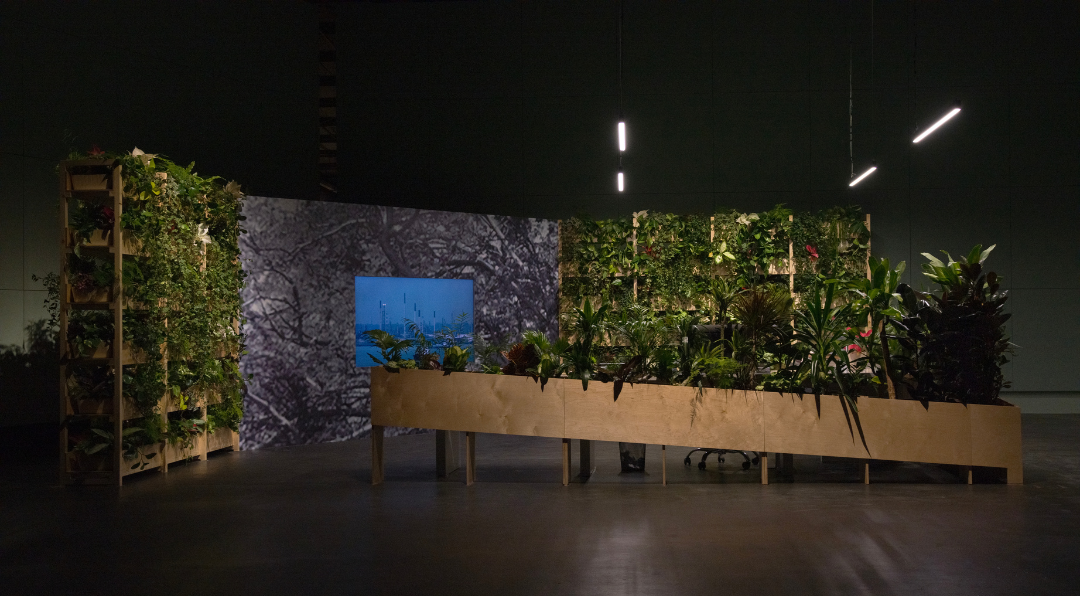
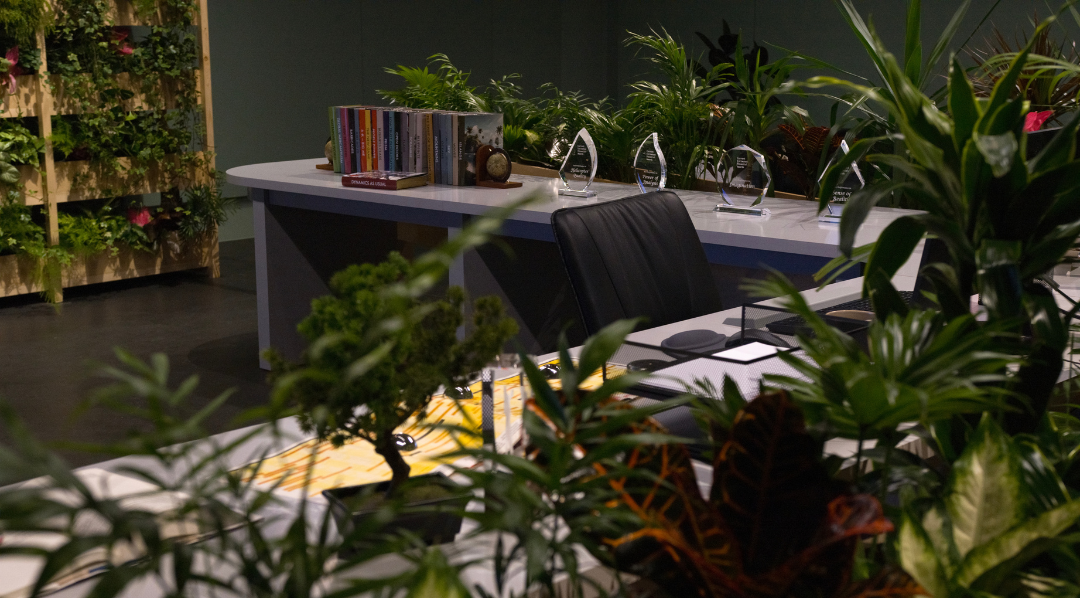
'A Petropolis in a Garden with a Long View'. 2024–26. Video installation with laser-etched crystal, acrylic awards, books, globe-shaped bookholders, newspaper, magazine, mug, workspace accessories, office table and chair, wall shelves, planter boxes, assorted plants, wallpaper. Installation view, Diriyah Contemporary Art Biennale 2026: In Interludes and Transitions, Riyadh, Saudi Arabia, 2026. Courtesy of the artist
The lecture ends with: “If soon after this photograph was taken, trees would only be planted in the name of the economy, here the tree opens us up towards worlds that the economy can never enter.” Ho does not say exactly what this tree might be a portal to; perhaps the possibility of de-centring the importance of human perception in conceiving the world. If this seems like a non-prescriptive, glancing reference to mysterious and unnamed emancipatory worlds over which “the economy” does not rule, my guess is that Ho is gesturing to radical alternative realities that by their nature, resist representation.
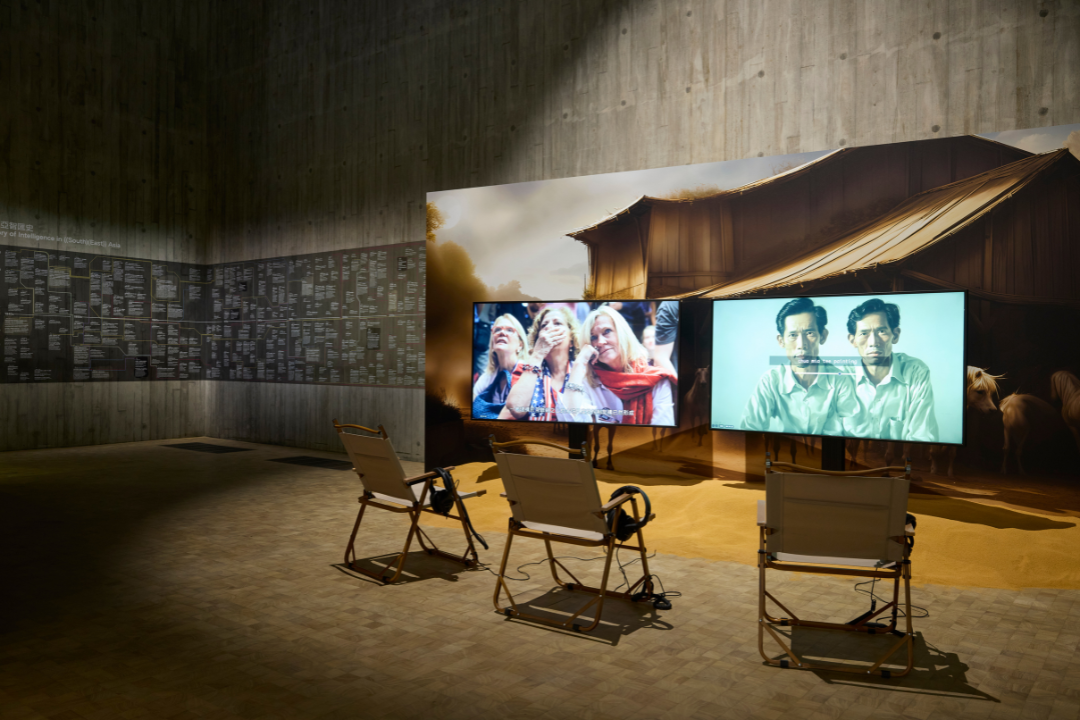
'Figures of History and The Grounds of Intelligence' 2024. Lecture and video installation with live AI-generated images, wallpaper and sand, 74’. Installation view, Sigg Prize 2025, M+, Hong Kong, 2025. Courtesy of M+, Hong Kong. Photo: Lok Cheng
Ho touches on the idea of the futility of drawing on what is an already-debased database of images in the performance lecture Figures of History and The Grounds of Intelligence (2024). The meandering performance explores the colonial histories of the so-called “globally networked” city, cybernetics, Singapore’s Smart Nation technologies, time-loop films, deep learning models, data capitalism and the ahistorical and amoral nature of generative AI, amongst other topics. One of its contentions is that using AI to find solutions for our present-day crises actually forecloses our options, because, through the structural limitations of its processes, “what’s produced by AI is not really the future per se in all its indeterminacy but merely an ‘original’ reorganisation of an abstracted version of the past.” At the end of the lecture, Ho throws out a series of speculative questions: “What if AI one day starts to gain historical consciousness? Would it make judgments about history like we do? And assuming that such an AI would have been trained on all the images of the world and had access to unlimited computing power, what kind of images would such an AI produce?”
Ho says this politically-informed AI would be drawing from images that have been underwritten by “histories of imperial extraction, capitalist exploitation, ethnonationalism and planetary destruction.” The AI “would be so burdened by the weight of history that it will decide that the best possible outcome is not to represent at all.” It would seem that visual representation, or at least the kinds that are extracted and reconfigured from historically dubious sources, only shuffles cards from the same rigged deck—the deck where images are capital.
In occlusions and opacities—perhaps like Ho’s reference to a mysterious fallen tree—might exist the possibilities of playing from a different deck of cards. Returning to Ho’s totemic table in The Economy Enters the People, not having a seat at this table, or not being politically represented in an already broken system, is a way to escape the logic of that system. I’m thinking of the “undercommons” in Fred Moten and Stefano Harney’s seminal essay collection, The Undercommons: Fugitive Planning & Black Study (2013), where they draw on the black radical tradition to develop new oppositional solidarities that defy easy categorisation. They write: “We’re more than politics, more than settled, more than democratic. We surround democracy’s false image in order to unsettle it. Every time it tries to enclose us in a decision, we’re undecided. Every time it tries to represent our will, we’re unwilling” and “we got politics surrounded. We cannot represent ourselves. We cannot be represented.” The best possible choice for Ho’s imaginary historically conscious AI, which has unlimited access to all images and computing power—being a kind of god, basically—is in relinquishing its power. By respecting and preserving spaces where subjectivities cannot be rendered as information, and hence capital, invisibility, rather than visibility, is the more radical political option.
Artist Bio
Ho Rui An is an artist and writer working in the intersections of contemporary art, cinema, performance and theory. Through lectures, essays and films, his research examines the relations between labour, technology and capital across different systems of governance in a global age. He has presented projects at the Shanghai Biennale; Bangkok Art Biennale; Gwangju Biennale; Jakarta Biennale; Kochi-Muziris Biennale; Haus der Kulturen der Welt, Berlin; Kunsthalle Wien; Singapore Art Museum; Van Abbemuseum, Eindhoven; and Yamaguchi Center for Arts and Media, Japan.
Author Bio
Adeline Chia is a writer and editor from Singapore. She contributes regularly to platforms such as e-flux, ArtReview and the Financial Times and is the Reviews Editor of ArtReview Asia.
Endnotes
1 S. Ortmann and M. Thompson, “China and the ‘Singapore Model’,” Journal of Democracy, 27, no. 1 (2016): 39–48.
2 F. Guattari. “Capital as the Integral of Power Formations” in Soft Subversions, ed. Sylvere Lotringer (Semiotext(e): 2009), 244–264.
3 F. Guattari. “Capital as the Integral of Power Formations,” 257.
4 Ho Rui An, Spectacular Liberal Exception (The Substation, 2017), 14.
5 Ian Tee, “Conversation with Singaporean artist Ho Rui An,” Art & Market, https://www.artandmarket.net/conversation/2024/7/15/conversation-with-singaporean-artist-ho-rui-an (accessed Feb 27, 2026) br />